If you have both stomach pain and back pain, you have probably already searched for this. And you have probably found the same list of answers every time: gallstones, kidney stones, pancreatitis, appendicitis. Structural conditions that connect the two symptoms through anatomy.
But what happens when you have been checked for all of those things? When the tests come back normal, or inconclusive, and both the stomach pain and the back pain are still there, and nobody has given you an explanation that actually accounts for why they keep showing up together?
For a significant number of people with chronic symptoms in both places, the answer is not anatomical. It is neurological.
When stomach and back pain occur together acutely, structural causes are the right place to start. Kidney stones, gallbladder disease, pancreatitis, and other conditions can genuinely cause pain in both areas simultaneously, and they need to be ruled out. If you have sudden, severe, or worsening pain in both areas, a medical evaluation should come first.
But when stomach pain and back pain have both been present for months or years, when tests have come back normal or inconclusive, and when no structural explanation has fully accounted for what you are experiencing, something else is worth considering.
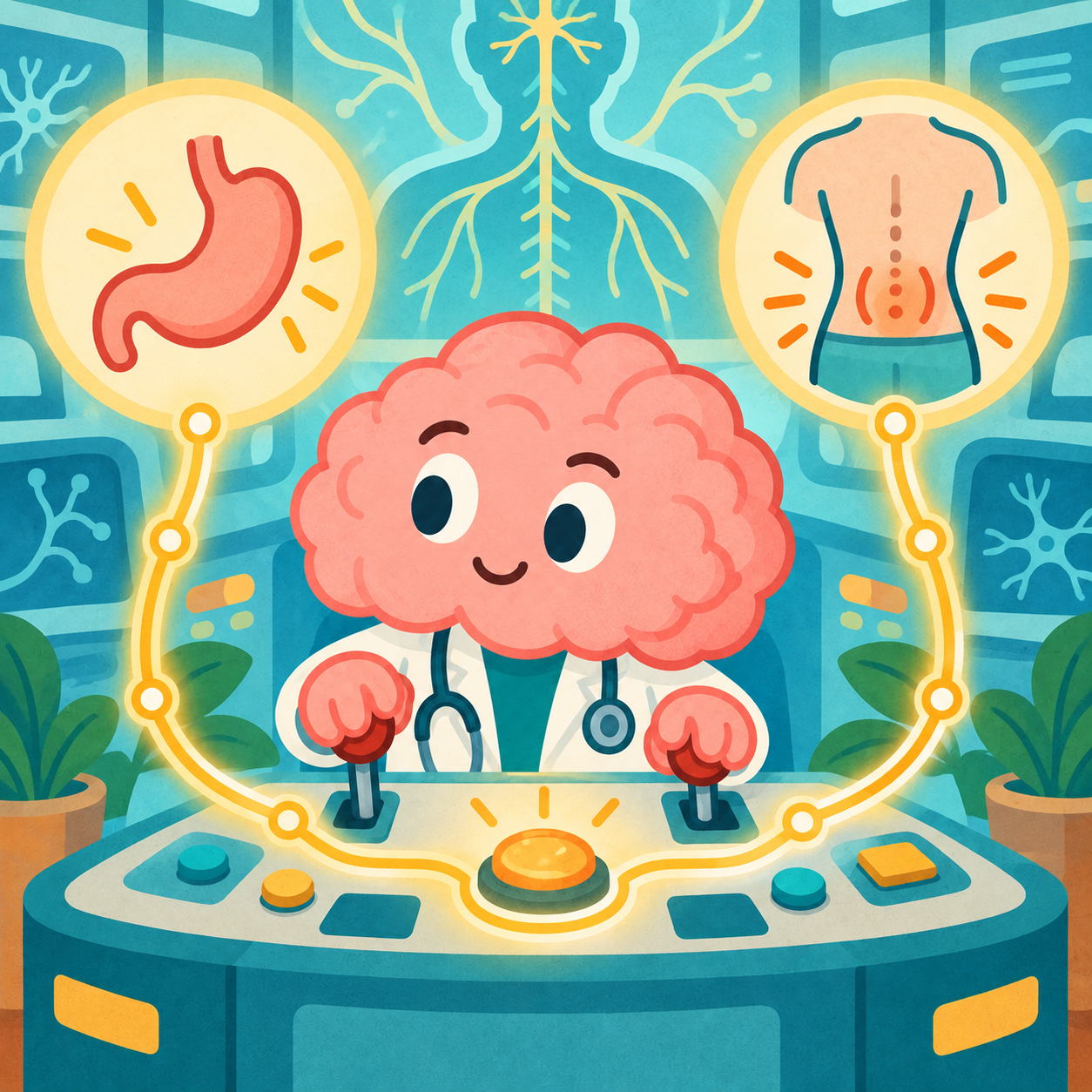
The explanation most people never hear is this: chronic stomach pain and chronic back pain frequently share a common driver. Not a single anatomical structure connecting them, but a central nervous system that has become sensitized and is amplifying pain signals across multiple body systems at the same time.
Central sensitization is the term researchers use to describe a state in which the central nervous system, the brain and spinal cord, begins processing incoming signals as more threatening than they actually are.
Central sensitization does not stay confined to one body region. When the nervous system's threat-detection system is running in an amplified state, that amplification extends across body systems. This is why people with centrally sensitized nervous systems so often have pain in multiple places, and why those pains so often appear unrelated to each other when each is examined independently.
Irritable bowel syndrome, one of the most common causes of chronic abdominal pain, is now understood by researchers to be driven substantially by this kind of central sensitization. The International Association for the Study of Pain has formally established a third category of pain mechanism to describe pain arising from altered nociceptive processing in the central nervous system without evidence of actual tissue damage or nerve lesion.
They call it nociplastic pain. IBS, fibromyalgia, and many presentations of chronic back pain all fall into this category.
They are not three separate conditions requiring three separate treatments. They are three expressions of the same sensitized nervous system.
Fitzcharles MA, Cohen SP, Clauw DJ, Littlejohn G, Usui C, Häuser W. Nociplastic pain: towards an understanding of prevalent pain conditions. Lancet. 2021;397(10289):2098-2110. doi:10.1016/S0140-6736(21)00392-5.
The overlap between IBS and chronic back pain is not anecdotal. It is documented in research, and the numbers are significant.
A major NIH-funded study examining the co-occurrence of five common chronic pain conditions, including chronic back pain and IBS, found that overlap among these conditions was the norm rather than the exception. People with IBS were roughly 2.6 times more likely to also have chronic low back pain, and the relationship runs the other way too: people with chronic low back pain were over three times more likely to have IBS. Among people with fibromyalgia, 90% had at least one other overlapping pain condition.
A separate line of research makes the nervous system mechanism concrete. Studies by Verne and colleagues found that IBS patients showed pain hypersensitivity not just in the gut, but in the hands and feet as well. When researchers applied heat, cold, and pressure stimuli to IBS patients' limbs, the same amplified pain response appeared there as in the digestive system. The gut was not producing a local problem. The central nervous system was generating a systemic one, and the gut was simply where it was most loudly expressing itself.
A follow-up study found that somatic hypersensitivity in IBS patients was greatest in the lower extremities, which share nerve pathways with the colon through viscerosomatic convergence, and that many IBS patients in that study also reported back pain, migraine, and muscle pain in areas entirely distinct from the gut. The researchers interpreted this as consistent with central nervous system dysfunction rather than localized gut pathology.
Slade GD, Greenspan JD, Fillingim RB, et al. Overlap of five chronic pain conditions: temporomandibular disorders, headache, back pain, irritable bowel syndrome, and fibromyalgia. J Oral Facial Pain Headache. 2020;34(Suppl):s15-s28.
Verne GN, Robinson ME, Price DD. Hypersensitivity to visceral and cutaneous pain in the irritable bowel syndrome. Pain. 2001;93(1):7-14.
Zhou Q, Fillingim RB, Riley JL 3rd, Verne GN. Central and peripheral hypersensitivity in the irritable bowel syndrome. Pain. 2010;148(3):454-461. doi:10.1016/j.pain.2009.12.005.
The gut and the brain are in constant bidirectional communication through what researchers call the gut-brain axis: a network of neural, hormonal, and immune signals connecting the digestive system to the central nervous system.
This connection runs both ways. The brain influences gut function, and the gut influences brain and pain processing.
Emeran Mayer, one of the leading researchers on this connection, describes IBS as a disorder of brain-gut interaction rather than a disorder of the gut itself. Most IBS patients are not just dealing with gut symptoms. Fatigue, sleep problems, cognitive difficulty, and pain in other parts of the body including the back are part of the picture too. These are not coincidental add-ons. They reflect a nervous system operating in a broadly dysregulated state rather than a gut with an isolated mechanical problem.
Mayer EA, Ryu HJ, Bhatt RR. The neurobiology of irritable bowel syndrome. Mol Psychiatry. 2023;28(4):1451-1465. doi:10.1038/s41380-023-01972-w.
In 1999, researchers Wessely, Nimnuan, and Sharpe published a paper in The Lancet that identified a problem in how medicine handles these conditions. They observed that each medical specialty has developed its own name for chronic symptoms without clear structural explanation: gastroenterologists call it irritable bowel syndrome, rheumatologists call it fibromyalgia, spine specialists call it chronic back pain, neurologists call it tension headache.
Each specialty treats its version as a distinct condition specific to the system it oversees.
Their conclusion: the differentiation of these syndromes is largely an artifact of medical specialization, not a reflection of truly distinct underlying diseases. Patients are labeled based on which doctor they see rather than based on what is actually driving their symptoms.
The result for someone with both stomach pain and back pain is predictable. They see a gastroenterologist for the gut, who runs the appropriate tests, finds nothing alarming, and offers a diagnosis of IBS. They see a spine specialist for the back, who orders imaging, finds nothing structurally significant, and offers a diagnosis of non-specific low back pain. Each doctor treats their half of the picture. Neither is looking at the whole.
There is an old saying: if all you have is a hammer, everything looks like a nail. When your only tool is a gastroenterology workup, the answer will always be a gut diagnosis. When your only tool is spinal imaging, the answer will always be a back diagnosis. This is not a failure of either clinician. It is a structural limitation of how medicine is organized around body systems rather than around mechanisms.
Wessely S, Nimnuan C, Sharpe M. Functional somatic syndromes: one or many? Lancet. 1999;354(9182):936-939. doi:10.1016/S0140-6736(98)08320-2.
One of the most important reframes this research offers is that pain in multiple body systems is itself a diagnostic signal rather than a sign of diagnostic complexity. And for many people, it is actually reassuring information.
A structural problem in one body part is one thing. Two or more separate structural problems, each independently producing chronic symptoms without a clear finding, is statistically unlikely. Multiple chronic pain conditions in the same person is one of the strongest signals that the nervous system is the common driver.
Per the IASP criteria for nociplastic pain, the presence of pain across multiple anatomical regions combined with associated symptoms like fatigue, cognitive difficulty, and sleep disruption supports a centralized pain mechanism.
When someone has both chronic stomach pain and chronic back pain, along with other symptoms that do not fit neatly into one specialty's domain, that picture is pointing toward the nervous system as the driver of all of it.
This matters because it changes what treatment is most likely to help. Treating each symptom in isolation with specialty-specific interventions addresses the surface presentation without reaching the underlying mechanism.
Approaches that work with the central nervous system directly, helping it reduce its overall level of threat amplification, can address multiple symptom systems simultaneously.
Clauw DJ. Fibromyalgia: a clinical review. JAMA. 2014;311(15):1547-1555. doi:10.1001/jama.2014.3266.
Understanding that chronic stomach pain and chronic back pain frequently share a nervous system driver changes how treatment can be approached.
Pain Reprocessing Therapy is built on the premise that the brain can generate pain in the absence of ongoing tissue damage, and can therefore learn to respond differently. For patients with multiple chronic pain conditions, PRT does not require separate treatment plans for each body system. It works with the nervous system driving all of them.
Patients who come to PRT managing both chronic gut pain and chronic back pain often find that as the nervous system's overall threat response begins to settle, symptoms across multiple systems shift together. When the common driver is addressed, the multiple expressions of it tend to quiet at the same time.
The specific techniques of PRT, including
somatic tracking, safety reappraisal, and addressing the fear and threat responses that maintain sensitization, are not aimed at the gut or the back specifically. They are aimed at the sensitized nervous system expressing through both.
This article is written for people whose structural causes have already been ruled out. If you are experiencing new, sudden, or worsening pain in both areas, or if you have not yet been evaluated by a physician, please seek medical care first. Conditions like kidney stones, gallbladder disease, and pancreatitis need to be ruled out before a nervous system explanation should be considered. Nothing here is intended as a substitute for medical evaluation.
This article is written for people whose structural causes have already been ruled out. If you are experiencing new, sudden, or worsening pain in both areas, or if you have not yet been evaluated by a physician, please seek medical care first. Conditions like kidney stones, gallbladder disease, and pancreatitis need to be ruled out before a nervous system explanation should be considered. Nothing here is intended as a substitute for medical evaluation.
Chronic stomach pain and chronic back pain co-occur far more than chance would predict. The most robust explanation, supported by multiple research traditions, is that they share a common driver: a central nervous system operating in a state of amplified threat response that expresses across body systems simultaneously.
This is not the explanation most search results give, and it is not what most specialists offer, because the specialty system is not designed to look across body systems at once. But it is the explanation the research actually supports, and the one that opens treatment doors the symptom-by-symptom approach keeps closed.
If you have been living with both, and neither has been fully explained, the nervous system explanation is worth understanding.
Prefer to find a PRT-trained provider near you or through telehealth?